- Sit a human behind a steering wheel and the output is an uncontrollable projectile.
- We forget about good behaviour because we feel invisible and untouchable in our armour.
- We are actually all losers who think they are winners.
- Convertible drivers honk less. The open roof changes everything.
Let's do some finger pointing as to why.
- It's you: you lose yourself in your car.
- It's traffic: there are more wheels on the road.
- It's society: Western society hails individual performance.
And so, road rage is widespread, pathetic and not so simple to handle.
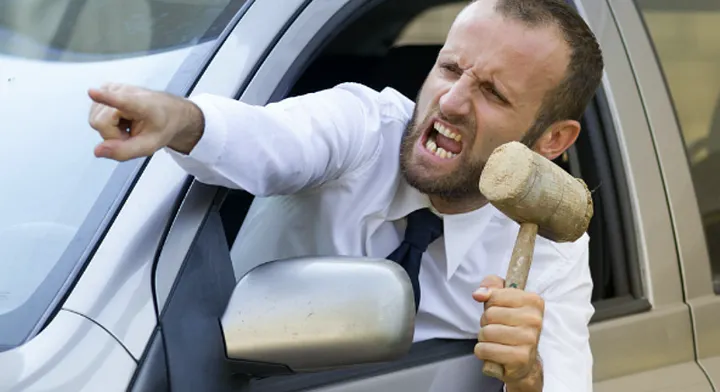
Sit a human behind a steering wheel and get him a set of wheels: the output is an uncontrollable projectile. Take 'Motor Mania' by Walt Disney: the film is over 70 years old and still incredibly timely. We meet Mr. Walker. This looks like a fine, decent citizen too gentle to kill a fly. But when he gets into his yellow car, he becomes Mr. Wheeler: an uncontrollable monster of a man that tears up the tarmac. This skunk of a driver rants and raves and scares pedestrians out of their pants. Mr. Wheeler is the prototype of the traffic aggressor of the 1950's. And it doesn't look like the type has evolved much. Also today, the aggressive driver's signature includes tailgating, cutting off, honking whenever wherever, swearing, obscene gestures, flashing from one lane to another, driving on an emergency lane, not giving way, not letting others pass and excessive speed.
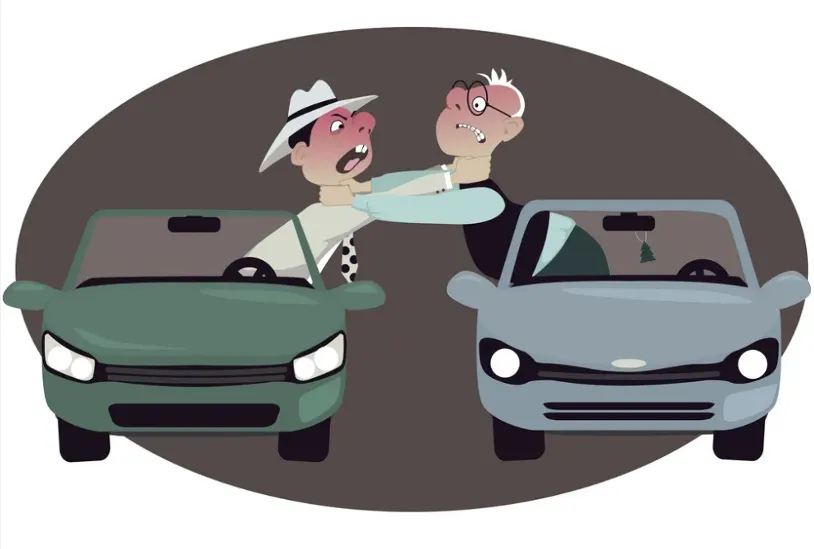
Let it all out
I mean, who hasn't been on the receiving end of such generosities? Many of us, decent citizens, have. And only a minority also admit to sinning themselves. Surveys: numbers can mean anything depending on whose side you're on. When we get the chance, we conceal the truth.
We forget about good behaviour, because we feel invisible and untouchable in this armour, that is our car. This is supported by fun field research. Researchers had a car block an intersection and then observed how other drivers reacted. What happened? Convertible drivers honked less quickly and less frequently than those with the roof closed.
We are occasionally taken aback by our bad behaviour. On a dull Monday, a tailgater is enough to awaken the Mr. Wheeler in all of us. How can we be so shamefully awful, rude and impolite? One explanation is that with the windows and doors closed, it is more difficult to empathize with others' situations. Which also explains why we need traffic rules.
When wheels and pedestrians have to share the same territory, these rules are not optional. And even if the rules are followed to the last dot, success is not certain. We are humans and our brain plays tricks on us. Research shows that people who got out of the car, as pedestrians, were still more reckless on the road for a while than other pedestrians who just stepped out of their home for a nice walk. Trusting common sense or good will is simply not good enough to stay safe.
Mute communication
We have a hard time staying human in the car, writes Tom Vanderbilt in Traffic. When we get into the car, we put on a harness and it limits our sensory abilities. Due to the lack of adequate communication tools, our conversation becomes quite basic and primitive: headlights, brake lights, horn and at best some sign language — that's about it. And so, in complex traffic situations this gives rise to misunderstandings and frustration. If someone flashes the headlights, what does that mean? Out of my way before I run you over? Maybe it's a friendly gesture — your taillights are defective? Or: didn't I see you at that party yesterday? Even those who have the best of intentions flashing the headlight risk getting the middle finger by those failing to read the signal.
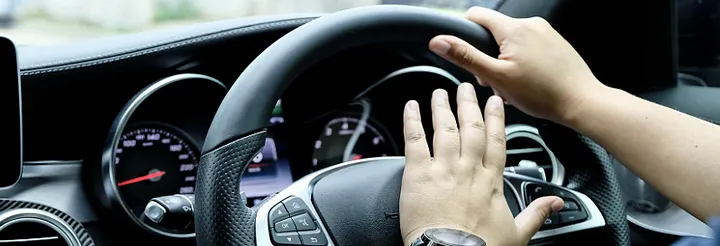
Even stranger behaviour: why do drivers talk to the rear lights of the vehicle in front of them? We know that the driver for whom the message is intended does not hear us. It's a ridiculous way of communicating. We speak up, even though we know we are not being heard. While driving, we lose the ability to express ourselves effectively. And admittedly, aggressive behaviour is a very efficient way to get noticed in traffic.
Losers everywhere
In the car we lose even more: pretty much all of our personality. Often, it is hard to see the driver behind the window. It is funny how we try to express ourselves nonetheless through our choice of model, fuel type, vanity plates etc. to make up for not being able to show ourselves to others. The other drivers are anonymous entities and so are we. We don't see them as people but as cars that get in our way to wherever.
Only on second sight do we 'discover' another person. The situation then becomes too complicated for us, humans, to handle. In order to control the other person, we make a mistake: we attribute behaviour to an assumed personality, independent of the circumstances. And as explained earlier, in traffic we know very little about the other drivers. And so we come to statements like: "I should have known: a woman!" without noticing that, for example, this person is having a gps-issue. This is referred to as the «fundamental attribution error» by social psychologists.
In our car, any sense of shame also disappears because we have the impression that nobody can see us. That is also suggested by research showing that drivers with passengers drive less aggressively than those without. Passengers are not afraid to correct us.
L'enfer, c'est les autres
We need to be corrected because we overestimate our capabilities as drivers. We assume that we are better drivers than average. But because we lose so much of our humanity in the car, we are actually all losers who think they are winners.
Fortunately, we can blame 'society'. The fundamental attribution error, for example, is said to be more common in cultures that value individualism over collectivism. In our individualistic society, we tend to hold people individually responsible for their behaviour without regard for group dynamics or the situation. We assume that in life we can get everything under control, if we want to. Other non-Western cultures see behaviour more in connection to circumstances. However, an eye on collective behaviour can also help to better understand individual behaviour.
Above average
I hate to break it to you, but thinking of yourself as performing above average sounds quite narcissistic. Narcissism is said to be on the rise in the West. Self-promotion on social media helps people to develop an inflated self-image. Harsh but also true: there is a link between narcissism and aggression. When the roads fill with narcissistic drivers, accidents will happen. Rules are not for above average drivers, right?
The link between narcissism and aggressive driving should not be exaggerated, yet something is going on. Could it be we overestimate our abilities as drivers because it is not clear what a 'good driver' is? One with a driver's license? In that respect, we become a better driver every day without accidents. Those kinds of illusions make us a better-than-average driver in our own eyes. While we probably just got lucky because other drivers paid better attention at crucial moments.
Everyone equal?
The road belongs to people of all ages, beliefs, and backgrounds. But is the road a true reflection of our society? Or is it a society on itself with its own rules and behaviour? In any case, it is a system of rules that everyone has to conform to in order for it to function. If the rules only apply to others, there's a problem.
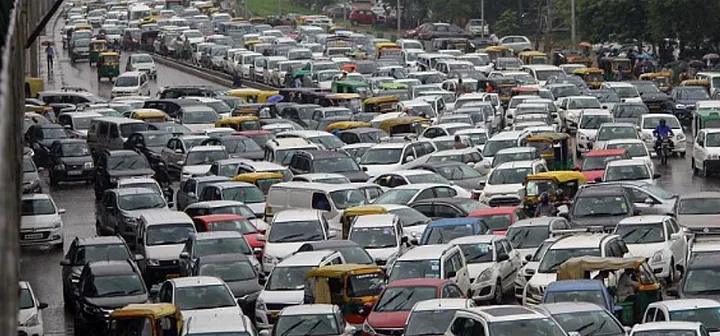
Adding another problem: there's simply more traffic and more sorts of wheels, which adds to the complexity of modern-day traffic. Traffic these days makes us think less and less of freely and happily moving about, but more and more of conflict, traffic jams, accidents, environmental problems and noise pollution.
Fortunately, something can be done: stay cool and do not provoke other aggressive drivers like myself. Studies have shown that drivers concerned with safety are less likely to be irritated by delays or the aggression of other drivers. This suggests that safety education can help to combat frustration and aggression in traffic. Better information about traffic rules also relieves the pressure. A better understanding gives us more control over ourselves and the situation.
Balls of a bull(y)
Researchers are trying to profile the bullies on our roads. Predicting who will turn out to be an aggressor is not so straightforward. It is also a matter of opportunity. Right, drivers are more likely to be bullies in traffic if they are male, relatively young, feel anonymous, are angry and think their driving skills are above average. But there also needs to be an 'opportunity' to explode. A nuisance such as a traffic jam, road works or another road user could do the trick.
Rumour has it bullies need to compensate what they don't have by driving like they have the balls of a bull. But seriously, there is no link between low self-esteem and aggression, nor between self-confidence and aggression. The opposite is true: people with unrealistically high self-esteem are more likely to react aggressively to protect their self-esteem. In extreme cases where criminal offences are committed, the aggressive driver is often going through an emotional process and is less well-off, but more wealthy men also appear in these statistics. Stress for longer periods of time plays an important role. In general, women commit fewer offences than men. But they too become aggressive after road provocations, and the gap between man and woman narrows when it comes to aggressive driving. In addition, American research shows that women curse — and even curse more — while driving than men. It is called verbal aggression, ladies.